
What Happens During a Truck Camper Consultation with BundutecUSA?
The right truck camper should fit more than your truck. It should suit thepeople you travel with, the places you want to go, and the way you like to spend your time at camp and away.
When you consult with BundutecUSA about our truck campers, we offer every potential customer, among other things, a consultation. We want to make sure the conversation helps us learn about your camping style and the truck you already have, so we can pair you with the truck camper that best fits your needs. You do not need to know exactly which model you want before we talk. That's often why people schedule a consultation.
1st: We start with how you want to travel
The best way to know what type of unit fits your needs is to understand how you want to travel. To learn this, we will discuss things such as:
• Are you planning weekend escapes or extended travel?
• Do you usually stay at established campgrounds?
• Do you want to spend more time away from hookups?
• Will you travel through cold weather, hot weather, or both?
We will also ask about your overall camping goals. Maybe you want to simplify setup, carry gear for a favorite activity, or travel for longer with the comforts that matter to you. Your answers help us focus on features you will use.
2nd: We talk about who is coming along
Finding a truck camper that fits your needs is more than how you travel; we also need to understand how many people will be traveling with you regularly. Are you a single traveler, do you have children, do you travel with a furry friend, or do you have guests tagging along?
We will also talk about life at camp. Some travelers want more room to cook and spend time indoors. Others spend most of the day outside and would rather prioritize gear storage or a compact camper. Knowing how you expect to use the space helps us compare layouts practically, since every model-and-truck pairing involves some compromise.
3rd: We review A truck and its ratings
Fitting the truck and camper can be a delicate balance, and you should consider many factors. We love trying to fit our campers to the truck you already have, so you don't need to incur additional costs upgrading a truck if that is not part of your plan or budget.
We will need to know the following information about the truck you plan to use, including:
• The truck's year
•Make
•Model
•Cab Style
•Bed Length
•Aftermarket modifications
It is also important to have a photo of, or know, the information on the Data sticker on the truck's door or door jamb.
This data sticker usually includes the truck’s gross vehicle weight rating (GVWR), front and rear gross axle weight ratings (GAWR), tire specifications, and a stated limit for occupants and cargo. That cargo figure is useful, but it does not tell us exactly how much camper weight your truck can carry in its current, travel-ready configuration.
This is how we use those stickers to calculate available payload
GVWR − actual truck weight = remaining capacity before adding the camper and anything else not yet loaded.
For example, let's take a dive into my personal truck: a 2019 Toyota Tacoma Off-Road Edition with a 5 ft box.
Here is the stickers located on my driver's side door jamb:
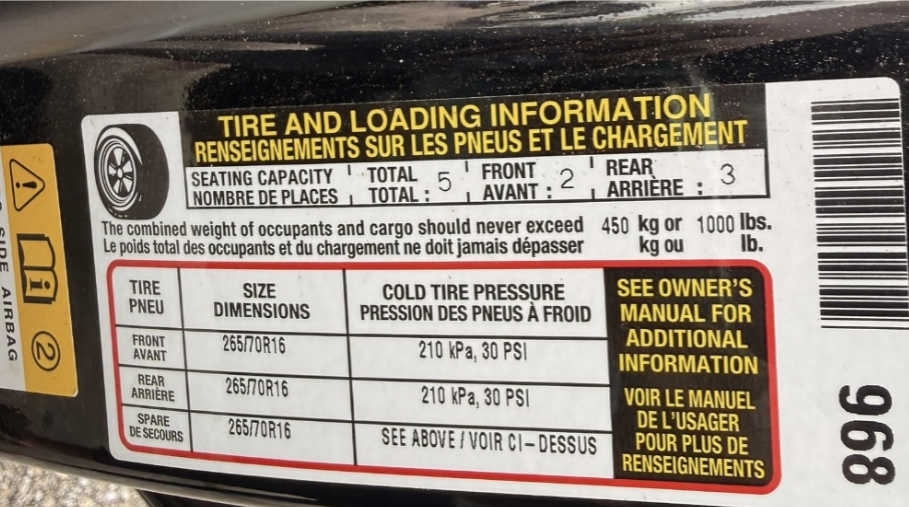
The bullet points of these stickers include:
• Listed Occupant Cargo Limit = 1,000 Pounds (this includes people, camper, and gear)
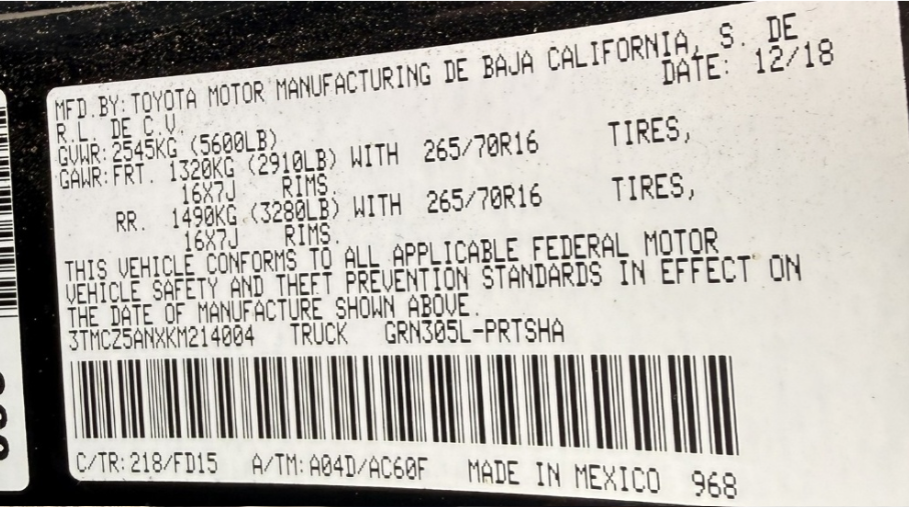
• GVWR = 5,600 Pounds (Maximum allowed weight of the loaded truck)
• Front GVWR = 2,910 Pounds (Maximum allowed weight on the front axle)
• Rear GVWR = 3,280 Pounds (Maximum allowedweight on the rear axle)
Using just these stickers as a starting point, we will take the GVWR and subtract the weight of the occupants and any aftermarket gear changes. As I travel with the tailgate removed, its weight can be added back into the calculation, as it is not part of the truck when I am ready to go camping.
This makes the calculation:
GVWR 1,000
Less:
Dozer and I at 270 Pounds
Aftermarket Changes to the truck = 0, although I have added 5,000 - pound-capacity airbags to my rear axle
Add:
Tailgate = 50 Pounds
This leaves a total weight allowance for my camper of 780 Pounds While this calculation is a great starting point, it is usually never very accurate.
The best way to find out what is allowable for your truck camper weight is to get a certified scale ticket for your truck. Then I can take my listed 5,600- pound GVWR and subtract the scale weight when the truck is prepped for the camper; this will provide me with the remaining weight before adding the camper.
Here is my certified scale weight on my truck with a full tank of fuel, myself, and Dozer inside:
This makes a more accurate calculation to be:
GVWR at 5,600 Pounds
Less: _____________ (actual weight of the truck)
Giving me a weight allowance for the camper of ____________
When considering the camper you choose, you also need to account for additional weight you'll add while camping, such as the camper's options, water capacity, propane capacity, batteries, food, clothing, and any additional gear still to be loaded. They say that most people carry 500 pounds of “stuff” when they load up to hit the road.
This weight calculation, however, is only one part of the review. We also want the scale’s front and rear axle weights so we can compare them with your truck's ratings. Tire and wheel load limits, the camper’s loaded weight, and its center of gravity also matter. A truck may be below its GVWR and still exceed another applicable limit, most commonly tire rating, which is why we always recommend an E-Rated HD tire when carrying a truck camper.
With my use of the RipTide, I have switched out my stock tires for a set of 4: LT265/75R16 Hankook Dynapro HT2 RH14; these are all-season, highway-focused tires because I don’t do much off-roading here in Iowa. They are 10-ply tires and have a maximum load capacity of 3,417 pounds per tire. While these tires do NOT increase my payload capacity of 1,000 pounds, they do mean I can safely support additional weight when traveling at highway speeds.
If you don't have a certified scale ticket yet, bring photos of the stickers and tell us what you've added to your truck. We can help you identify the measurements and weights to gather before settling on a camper.
4th: We explore the camper that fits your priorities
Once we understand your truck and travel plans, we can discuss the units and layouts that make sense to explore. We will talk about sleeping space, storage, kitchen and bathroom needs, heating and cooling preferences, and how you expect to use power when camping.
This is also a chance to discuss what comes standard, which options support your goals, and what may be required for installation. If you are considering a custom build, we can talk about the measurements and decisions needed to shape it.
Budget is part of the conversation, too. We want you to understand the complete build, including the camper, selected options, installation needs, and any applicable truck or flatbed considerations.
Final Thoughts: Come with questions, not a finished plan
You do not need to start a conversation about your truck camper needs with a model picked out or every measurement in hand; we just want you to bring what you know about your truck, a few ideas about how you want to travel, and the questions on your mind. We will work through the possibilities together and help you understand the next steps.
Ready to find a camper that fits your truck and your plans? We are here for you! If you are attending Overland Expo East, you can schedule a specific time to meet us at booth T44 or contact us directly to start a conversation about your needs if you can’t attend.